Frontier Markets Are Watching the Clock: Why the 23 October Guinea Bond Test Matters for Every Underserved Issuer

A claimed subscription close date of 23 October for a Guinea 'Simandou 2040' bond of Guinean franc (GNF) 2,500 billion has been circulating in frontier market commentary. As of this writing, the instrument has not been independently verified as a bond issuance with confirmed legal terms, issue size or settlement structure. Guinea's Simandou 2040 development strategy is an economic programme - not a bond.
Why This Matters Beyond Guinea
Whether the Guinea transaction closes as claimed or not, the episode illustrates a challenge that every frontier and underserved market issuer faces: the gap between a development programme and a verified, investor-ready bond issuance. That gap is where credibility is won or lost.
Frontier issuers often have compelling underlying assets - natural resources, infrastructure projects, sovereign guarantees - but lack the legal, structuring and distribution infrastructure to convert them into capital markets transactions.
Investors in frontier markets apply heightened scrutiny to documentation, settlement structure and regulatory standing. Unverified claims damage not just one issuer but the broader market's reputation.
The Democratic Republic of Congo (DRC) April 2026 inaugural Eurobond - United States dollars (USD) 1.25 billion, four times oversubscribed, more than 110 investors - succeeded precisely because it combined an International Monetary Fund (IMF) anchor, a commodity narrative and a credible legal and settlement structure.
The Africa Credit Rating Agency, launched 9 October 2026, represents a structural step toward independent credit assessment for African issuers - reducing reliance on the three major global agencies and potentially lowering the cost of accessing capital markets.
The DRC proved that frontier markets can access global capital - but only when the structure is credible, the documentation is verified and the investor base is properly engaged.
What Frontier Issuers Actually Need
Governments, development finance institutions and project sponsors in Africa, the Pacific Islands, Central Asia and the Caribbean face a common set of barriers: minimum deal sizes that exclude them from conventional syndication, limited access to European regulatory frameworks, and distribution networks that do not reach the global investor base.
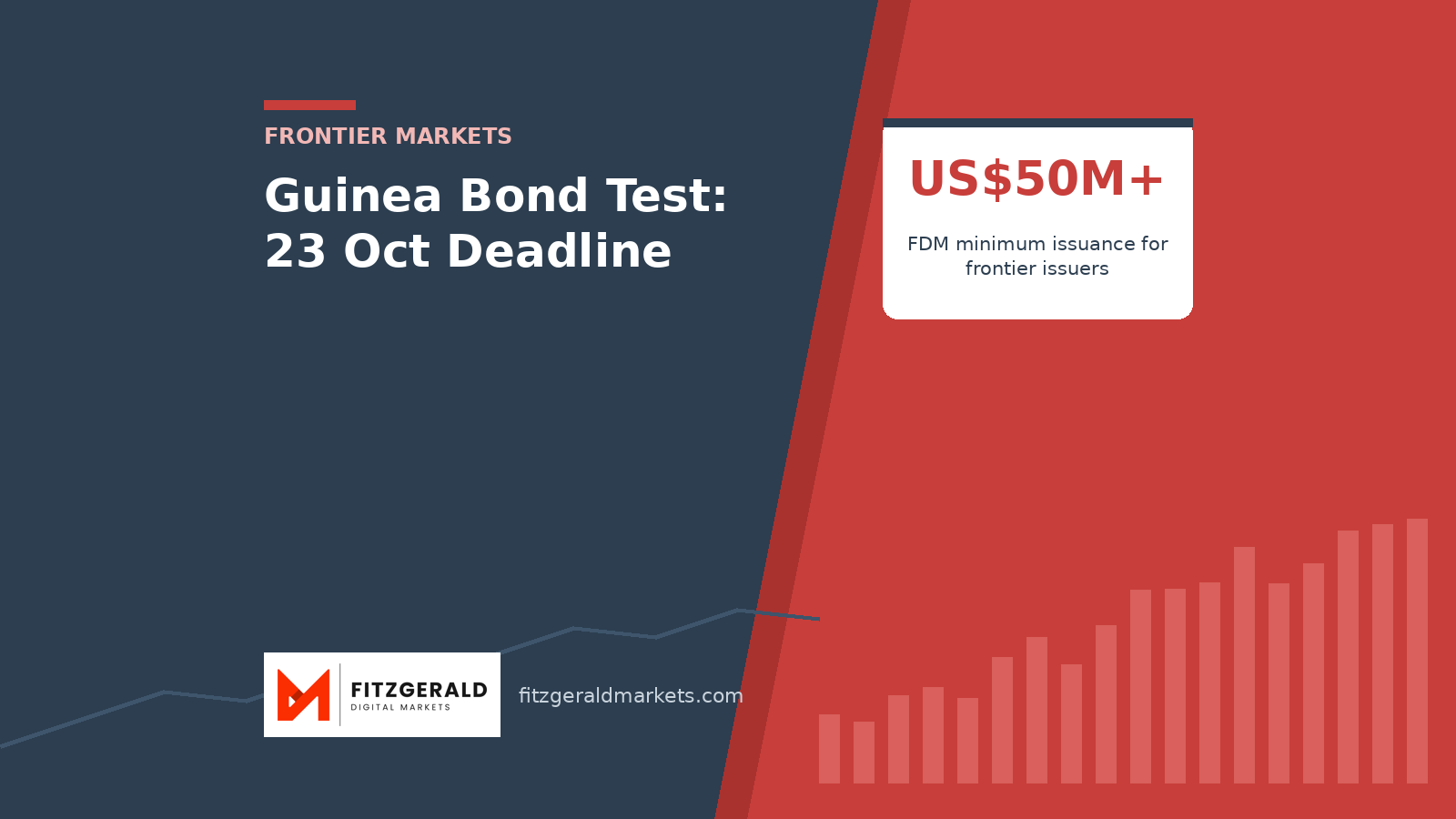
Fitzgerald Digital Markets (FDM) was built to address exactly these barriers. Our Luxembourg tokenised real-world asset (RWA) bond platform enables issuance from USD 50 million - a threshold designed to include the underserved issuers that conventional investment banks routinely pass over. Digital settlement, European regulatory standing under the European Union (EU) DLT Pilot Regime, and access to a global investor network mean that a government or project sponsor in a frontier market can reach institutional capital without needing a bulge-bracket mandate.
The Opportunity Is Real - The Execution Must Be Rigorous
Sub-Saharan Africa raised approximately USD 15.7 billion in the first quarter of 2025 - the strongest start to a year on record. The pipeline is real. But the lesson from episodes like the Guinea Simandou 2040 claim is that execution rigour is non-negotiable. Issuers who bring verified documentation, clear use of proceeds and a credible settlement structure will find investor appetite. Those who do not will find the market closed.
Contact FDM
Contact FDM


Comments