Tokenised RWA Market Climbs Back Above US$39 Billion: What the Recovery Signals for Bond Issuers

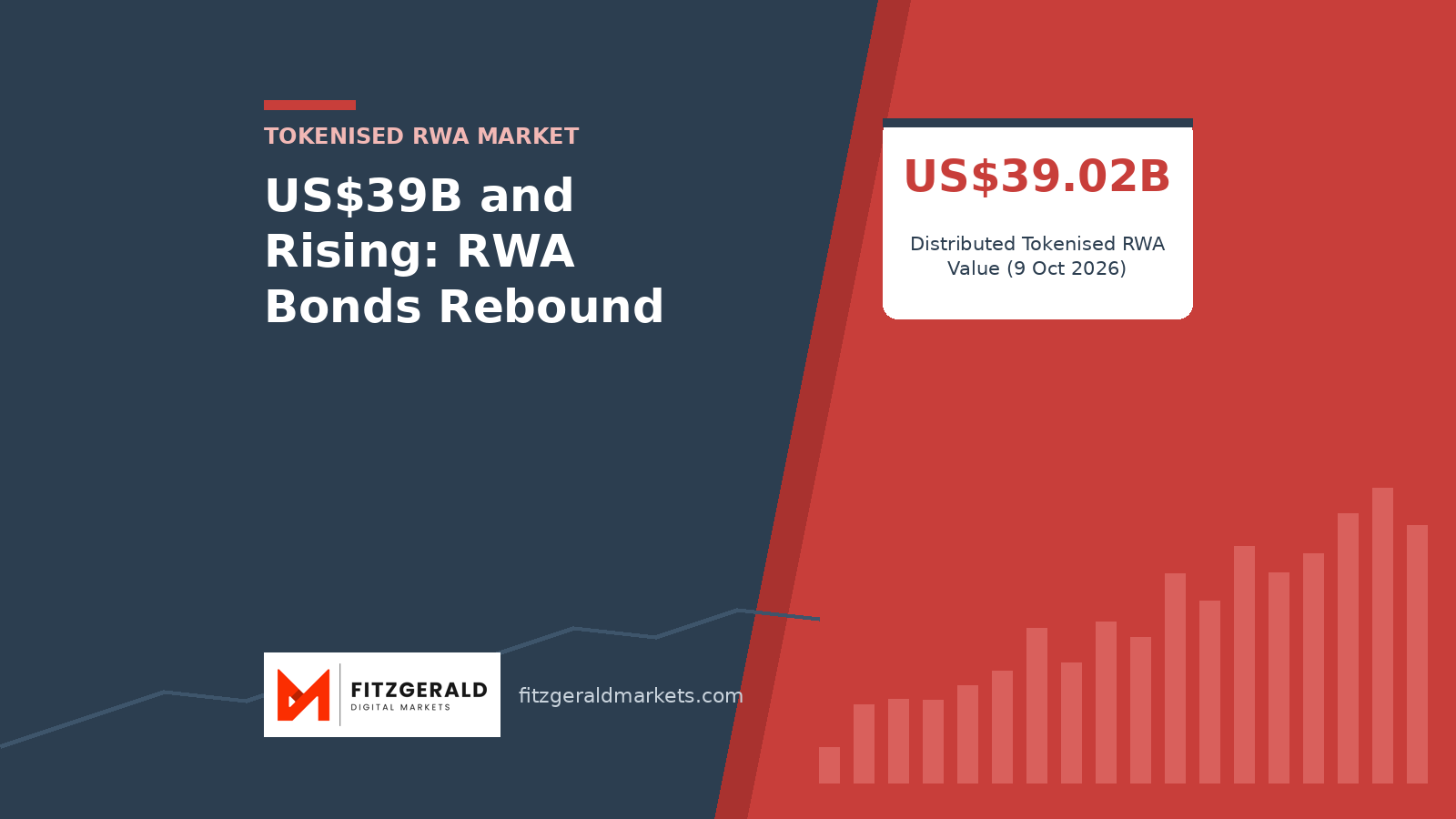
The global tokenised Real-World Asset (RWA) market has bounced back. After dipping to US$38.88 billion on 8 October, distributed tokenised RWA value recovered to approximately US$39.02 billion on 9 October 2026, according to RWA.xyz. That is a gain of roughly US$140 million in a single session, and it reinforces a clear directional trend: institutional capital is moving on-chain.
What the Numbers Actually Mean
Not all tokenised asset figures are equal. The US$39.02 billion figure represents distributed value: assets where blockchain functions as a genuine distribution layer, allowing investors to subscribe, hold and transfer positions through wallets or custodians. This is the commercially meaningful number for bond issuers.
A separate, much larger figure of US$351.97 billion represents represented value, where distributed ledger technology (DLT) is used primarily for record-keeping rather than investor-facing distribution. Issuers and investors should focus on the distributed figure when assessing real market depth.
Tokenised United States (US) Treasury funds: approximately US$14.95 billion - the largest single category
Non-US government debt tokenised: US$926.78 million - a growing segment for sovereign issuers
Tokenised credit: US$8.03 billion - demonstrating corporate appetite for on-chain distribution
Why European Settlement Infrastructure Changes the Game
ECB Pontes, operational since 21 September 2026, connects market DLT platforms directly to T2, the Eurosystem's settlement system, enabling atomic delivery-versus-payment in central-bank money.
This is not a pilot or a proof of concept. Pontes is live infrastructure that solves the single biggest barrier to institutional tokenised bond adoption: settlement risk. When delivery and payment occur simultaneously in central-bank money, the counterparty risk that has historically deterred conservative institutional investors is eliminated.
For a Luxembourg-based issuance platform, Pontes provides direct interoperability with regulated euro settlement. That means a tokenised bond issued through Fitzgerald Digital Markets (FDM) can settle with the same finality and regulatory standing as a conventional Eurobond.
The Opportunity for Underserved Issuers
The tokenised RWA market is growing, but access remains concentrated. Governments, corporations and banks from frontier and emerging markets have historically been priced out of conventional Eurobond markets by high minimum deal sizes, complex documentation requirements and limited investor reach.
FDM's Luxembourg platform changes that equation. With issuance from US$50 million, underserved issuers can access global institutional investors through a regulated, DLT-native structure that is now backed by Pontes-compatible settlement. The Uzbekistan Uzum bond, which began trading at precisely the US$50 million threshold on 6 October, demonstrates that frontier-market issuers can successfully access foreign-currency capital at this scale within a supervised regulatory sandbox.
What This Means for Your Organisation
Governments: Access global investors for infrastructure and development bonds from US$50 million, with European regulatory standing and atomic settlement
Corporations: Diversify your funding base beyond domestic markets, reaching institutional tokenised-asset investors in a growing US$39 billion market
Banks: Issue Tier 2 capital instruments or structured products through a platform designed for underserved issuers, with full DLT-native distribution
Contact FDM
Contact FDM to explore how our Luxembourg tokenised bond platform can open global capital markets for your organisation.


Comments