US Yields Above 5%: Why the Cost of Capital Is Now Your Biggest Issuance Decision

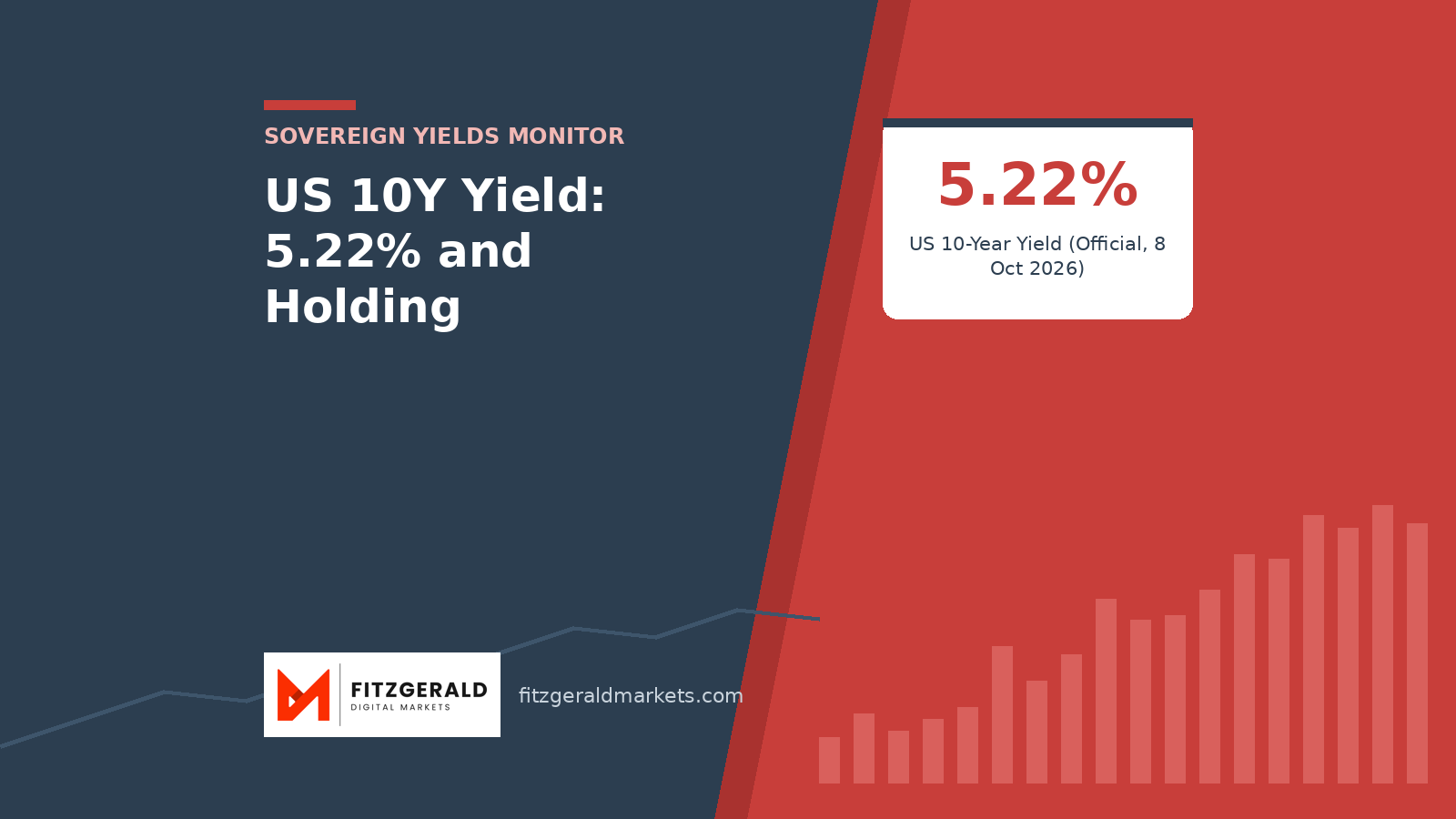
United States Treasury yields are not retreating. The official Federal Reserve H.15 constant-maturity rate for the 10-year bond stood at 5.22% as of 8 October 2026, with the 30-year at 5.60% and the 20-year at 5.64%. Market indications for 10 October placed the 10-year at approximately 5.24%. That is not a blip: it is a sustained repricing of the global cost of capital.
What the Numbers Mean for Issuers
When United States (US) benchmark yields hold above 5%, every other sovereign and corporate issuer faces a higher hurdle rate. Spreads over US Treasuries may remain historically tight, but the absolute coupon cost of a new bond is materially higher than it was two years ago. For governments in frontier and emerging markets, that means more of the budget goes to debt service and less to development.
The Federal Reserve (Fed), European Central Bank (ECB), Bank of England (BoE), Bank of Japan (BoJ) and Reserve Bank of Australia (RBA) have all held policy settings steady, with no new guidance since early October.
The Fed's Federal Open Market Committee (FOMC) minutes from 7 October and Governor Christopher Waller's 8 October speech were the last substantive communications: no pivot signal, no easing bias.
The Organisation for Economic Co-operation and Development (OECD) projects sovereign borrowing at approximately US$18 trillion in 2026. At current yield levels, refinancing that stock is expensive for every government in the queue.
Monday 12 October is the US Columbus Day holiday, with the Securities Industry and Financial Markets Association (SIFMA) recommending full fixed-income market closure. Tuesday's data will be the next clean read.
The Strategic Case for Acting Now
Waiting for yields to fall is a strategy. So is locking in today's terms before the next supply wave pushes spreads wider. The difference is who controls the timing.
For governments, corporations and banks considering bond issuance, elevated yields create a paradox: the cost is high, but so is investor demand for yield. Institutional investors are actively seeking fixed-income exposure at these levels. The issuers who move with a credible structure and a clear use of proceeds are the ones who get the deal done at the tightest spread.
Why Tokenised Issuance Changes the Equation
Fitzgerald Digital Markets (FDM) operates a Luxembourg-based tokenised Real-World Asset (RWA) bond issuance platform designed for issuers who need access to global capital markets without the full overhead of a traditional Eurobond programme. Issuance starts from US$50 million, making it accessible to governments, development finance institutions and corporations that fall below the threshold of conventional syndicated deals.
In a high-yield environment, the ability to reach a broader investor base digitally, settle efficiently via distributed ledger technology (DLT) infrastructure, and operate under a European regulatory framework is a structural advantage. The European Central Bank's Pontes settlement bridge, launched in September 2026, and the United Kingdom's Digital Securities Sandbox (DSS) pilot planned for early 2027 are building the rails that tokenised issuance will run on.
Contact FDM
Contact FDM to discuss how our platform can support your next bond issuance in the current rate environment.


Comments